
The journal · 10 July 2026
GSB Konkani wedding photographer, Mangalore & Udupi: planning
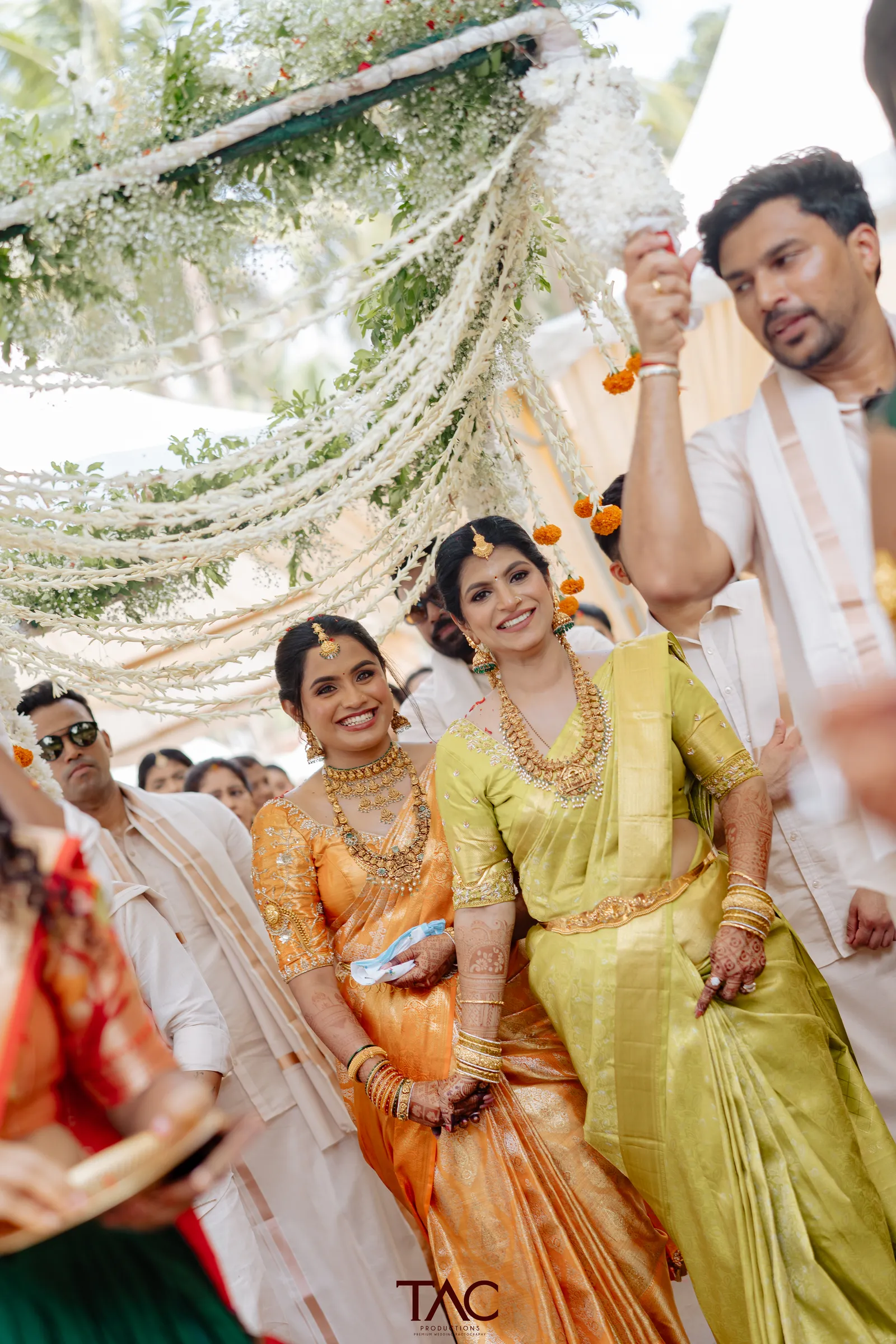
As a GSB Konkani wedding photographer working regularly across Mangalore & Udupi, the question we get most from couples isn’t which lens we’ll use — it’s how the day’s schedule should be built so the ritual sequence and the light both work in the couple’s favour. GSB weddings (Gaud Saraswat Brahmin, a Konkani-speaking community concentrated across this coast and Goa) follow a precise, priest-led order, and the planning has to follow that order rather than a generic template.
We’ve written separately about the rituals themselves — the Kashi Yatra, the dhare, the mangalsutra sequence. This post is about the planning layer around them: timing, coastal light, and the moments we ask families to protect on the schedule.
How a GSB Konkani wedding photographer plans Mangalore & Udupi weddings
GSB ceremonies typically move through a fixed sequence with real precision — several of the photographically important moments happen quickly and without much warning. We ask for a walkthrough of the family’s specific order well before the wedding, because building our position plan after the fact, mid-ceremony, is how a photographer misses the one moment that mattered most to the family. The venue’s own event timeline is a starting point, but the priest’s sequence is what actually governs where we stand and when.
Dhare: plan for one take
Dhare, the core giving-away ritual in GSB ceremonies, is performed under precise timing and doesn’t pause for a better camera angle. We position two angles in advance — one on the couple’s joined hands, one wide on the parents — because the ritual itself gives no warning and no repeat. As with Tulu dhare traditions on this coast, the specific form and emphasis can vary by family, so we confirm details rather than assuming a fixed script.
Kashi Yatra and the value of shooting it candidly
Kashi Yatra, where the groom playfully feigns leaving for a pilgrimage before being persuaded to stay, is one of the most naturally photogenic moments in a GSB wedding — full of real, unscripted laughter from both families. We treat it as a candid moment rather than a staged one: our job here is to stay out of the way and keep shooting, not to direct it.
Coastal light across Mangalore and Udupi
Mangalore and Udupi ceremonies share this coast’s light pattern but not its venues — Mangalore leans toward garden estates with tree canopy, Udupi toward open coastal lawns and beachfront resorts, and each behaves differently by the hour. A garden venue like Adyar Gardens in Mangalore gives soft, diffused light through much of the afternoon under its canopy; an open beachfront lawn in Udupi turns harsh by mid-morning and gentle again only in the last hour before sunset. Where a family has any flexibility in scheduling functions around the fixed ritual times, we factor this in — though we’re clear with every couple that the muhurtha itself is set by the priest, not moved for photography.
Vratha and the functions that get under-documented
Several ceremonial functions typically precede the main GSB wedding day, including the groom’s vratha. Families often save their full attention and their photography budget for the main ceremony and treat these smaller functions as optional coverage. In our experience they’re some of the least self-conscious, most re-watched images in the final gallery — we encourage at least light coverage of the larger pre-wedding functions rather than skipping them entirely.
Mangalsutra and saptapadi: two angles, not one
The mangalsutra and saptapadi sequence is often the emotional peak of a GSB ceremony for both families. We work two angles through this — tight on the couple’s hands, wide on the families watching — because both versions end up mattering to different people in the same gallery, and there’s no reshooting it afterward.
Language and why it changes what we catch
Being able to follow the priest’s Konkani instructions directly, rather than through a translated summary from a coordinator, changes what we’re able to anticipate in the moment. We speak Konkani alongside Kannada, Tulu, Hindi, and English, and it consistently means fewer missed transitions between rituals and a calmer flow to the day — something families notice even when they don’t mention it directly.
Where we’ve shot GSB weddings on this coast
We photograph GSB and Konkani weddings across Mangalore, Udupi and Kundapura. The GSB community’s close-knit network across this coast means many of our bookings come through word of mouth between families — a responsibility we take seriously in how consistently we approach each one.
Planning your GSB or Konkani wedding
If you’re planning a GSB or Konkani wedding across Mangalore, Udupi, or the wider coast, we’d welcome a conversation about your family’s specific ritual order before the day itself. Browse related work in our portfolio, or reach out to start planning.
— The Artsy Craftsmen